
How stock options actually work
Stock options can be valuable. But several things have to go right before they become money.
Written Nov 2021 · Updated Sept 2026
This note explains common share options at UK startups. I am not a lawyer or an accountant. The tax treatment depends on your circumstances and the exact documents you signed. Use this to ask better questions, then speak to someone qualified before making an expensive decision.
Someone tells you they have been offered 20,000 share options.
Is that a lot?
It sounds like a lot. But the number by itself tells you almost nothing.
Twenty thousand options could represent 20% of a very small company or 0.02% of a much larger one. They could cost almost nothing to exercise or require more cash than you have. And even after you buy the shares, you may not be able to sell them.
That is the confusing thing about share options. We talk about them as if they are shares. Then we talk about the shares as if they are money.
They are neither, at least not yet.
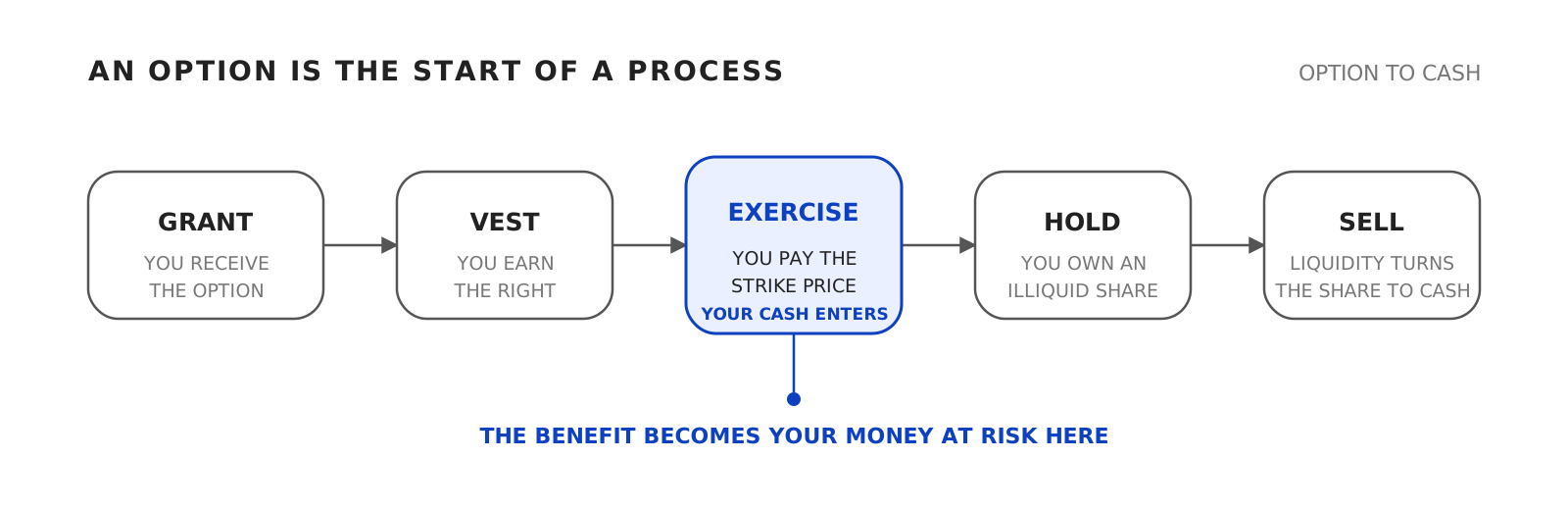
A share option is the right to make another decision later. You may eventually decide to use your own money to buy shares in the company. After that, you still need somebody to buy those shares from you.
So there are several steps between the number in your offer and money in your bank account.
The number in your offer means almost nothing
Let us use one simple example throughout this note.
You join a startup and receive:
- 10,000 share options
- a strike price of £1.13 per share
- four-year vesting with a one-year cliff
- 10 million shares on a fully diluted basis
The first useful calculation is not 10,000 x some imagined future share price.
It is this:
10,000 options / 10,000,000 fully diluted shares = 0.1%
Your grant currently represents 0.1% of the company on a fully diluted basis. Future fundraising and new option grants may dilute that percentage.
Why does the fully diluted share count matter?
Because 10,000 is only the numerator. If the company does not tell you the denominator, you still do not know what you have been offered.
And even 0.1% is not a cash value. It is only a percentage of a particular class of shares, subject to the company's financing terms.
An option is not a share
A share option gives you the right to buy a share at a fixed price during a fixed period.
That fixed price is the strike price, sometimes called the exercise price. In our example, it is £1.13.
If the company's ordinary shares later have a market value of £4.50, you can still buy each share for £1.13. That difference is the attractive part.
But you do not receive the share automatically. You have to exercise the option and pay for it.
HMRC describes a share option plan in much the same way: it gives an employee the right to buy a set number of shares at a set price. That definition is plain, but every part matters:
- A given number: how many options you were granted.
- A given price: what you must pay to exercise them.
- A given time: when they vest and when they expire.
Miss the last part and an apparently valuable option can disappear.
Vesting tells you when you earn the right
Most startup grants are earned over time. A common structure is four years with a one-year cliff.
In our example, if you leave after eleven months, you normally leave with nothing vested.
If you remain for twelve months, the first 25% vests at once:
10,000 options x 25% = 2,500 vested options
The remaining options then usually vest in smaller instalments over the next three years. The exact schedule is in the grant agreement.
The cliff is easy to misunderstand. It does not mean the company gives you a free year of shares on your first anniversary. It means you have finally earned the right to buy the first portion.
You still have to decide whether to spend the money.
There is another clock too. Options expire. And if you leave the company, your agreement may give you a much shorter period to exercise the vested options. There is no universal post-employment exercise period. Your documents decide the actual deadline.
So do not wait until your last working day to read them.
Exercising is where your money becomes real
Suppose all 10,000 options have vested and you decide to exercise them.
10,000 options x £1.13 strike price = £11,300 exercise cost
You send the company £11,300. The options become shares.
Now suppose the current market value of the ordinary shares is £4.50 per share:
10,000 shares x £4.50 = £45,000 market value
£45,000 - £11,300 = £33,700 spread
On paper, you bought something worth £45,000 for £11,300.
But the word paper is doing a lot of work here.
You may have spent £11,300 on shares that cannot be sold. And depending on the type of option, that £33,700 spread may also affect your tax bill.
This is the point where a benefit in an offer letter becomes your own money at risk.
The funding-round valuation is not the value of your shares
For an EMI scheme, a company can ask HMRC's Shares and Assets Valuation team to agree the market value of the shares before the options are granted. The company proposes both the actual market value, taking restrictions into account, and the unrestricted market value.
That is the number you want to ask for. But it still may not match the price from the company's last funding round. The company might then raise more money and announce a much larger valuation.
Why are the numbers different?
Because the investors and employees may not be buying the same thing.
Employees normally exercise options into ordinary shares. Investors may buy preference shares, which can include liquidation preferences, anti-dilution protection, information rights and other protections that the ordinary shares do not have.
There is no rule that says the preference-share price must be five or ten times the ordinary-share price. Sometimes the gap is large. Sometimes it is not.
The important point is simpler: do not take the headline company valuation, divide it by the number of shares and assume that is what your ordinary shares are worth today.
They answer different questions.
The tax can arrive before the cash
In the UK, the first useful question is whether your options are EMI options or non-tax-advantaged options.
The names are not the interesting part. The interesting part is when the tax can appear.
EMI options
EMI stands for Enterprise Management Incentives. It is a tax-advantaged share option scheme used by qualifying companies.
There is normally no Income Tax or National Insurance when a qualifying EMI option is granted. And if the option was not granted at a discount, there is normally no Income Tax or National Insurance when you exercise it either, provided the scheme conditions continue to be met.
When you eventually sell the shares, Capital Gains Tax may apply to the gain.
So in our example, if £1.13 was at least the agreed market value when the EMI option was granted, the later £4.50 market value does not automatically create an Income Tax charge when you exercise.
That is one reason EMI matters.
Non-tax-advantaged options
With a non-tax-advantaged option, the spread at exercise will normally count as employment income.
In our example, that spread is £33,700.
If the shares are readily convertible assets, for example because a sale is already being arranged, the tax is normally collected through PAYE and National Insurance can also be due. If they are not readily convertible, the Income Tax may need to be reported through Self Assessment and National Insurance will not normally apply.
That does not mean your tax bill is a fixed percentage of £33,700. Your income, residency and the exact transaction matter. But it does mean you can owe tax because you exercised, even though nobody has bought the shares from you.
And some agreements allow the employer's National Insurance on an option gain to be passed to the employee. Read that part too. It can make the exercise more expensive than the strike price suggests.
This is exactly why a casual tax summary can become expensive.
Leaving the company can start two clocks
The first clock comes from the option agreement.
It may say that vested options must be exercised within a particular period after you leave. Miss it and the options can lapse.
The second clock is the EMI tax clock.
Leaving the company is normally a disqualifying event for EMI. HMRC says that exercising within 90 days of a disqualifying event preserves the EMI tax advantages. Exercise later and part of the gain may become taxable as income.
These clocks are related, but they are not the same thing. Your agreement might give you less than 90 days, exactly 90 days or more. The agreement tells you whether you can exercise. The tax rules tell you what may happen if you do.
So do not ask only, "When do my options expire?"
Ask these two questions:
- What is my contractual deadline to exercise after leaving?
- What happens to the EMI tax treatment if I use that deadline?
That is another moment to stop reading internet explainers and speak to an adviser.
Owning shares does not mean you can sell them
You exercised. You paid the strike price. You dealt with the tax.
Can you sell now?
Possibly not.
Private-company shares are often restricted, and the articles or shareholders' agreement may contain pre-emption rights, a right of first refusal or other limits on transfer.
There are usually four ways liquidity may eventually appear:
- A public offering. The shares become publicly tradeable, although a lock-up may delay when you can sell.
- An acquisition or merger. The buyer pays cash, shares or a combination, subject to the terms of the transaction.
- A tender offer. The company or an approved investor offers to buy some shares from existing holders.
- A secondary sale. Another buyer purchases the shares, if the company and securities rules allow it.
None of these is guaranteed.
A company can remain private for years. It can stop allowing secondary sales. It can also fail.
So exercising is not the same as cashing out. It is buying an illiquid asset because you believe the possible future value justifies the cost and risk today.
A company can sell for millions and you can still receive nothing
This is the part people miss when they multiply their percentage by a possible sale price.
Suppose a company has raised £500 million from investors. For simplicity, assume those investors hold a one-times liquidation preference for the full £500 million.
The company is then sold for £500 million.
You own 1% of the ordinary shares. So you expect £5 million.
But the investors may be entitled to receive their £500 million preference before ordinary shareholders receive anything. In this deliberately simple example, nothing remains for the ordinary shares.
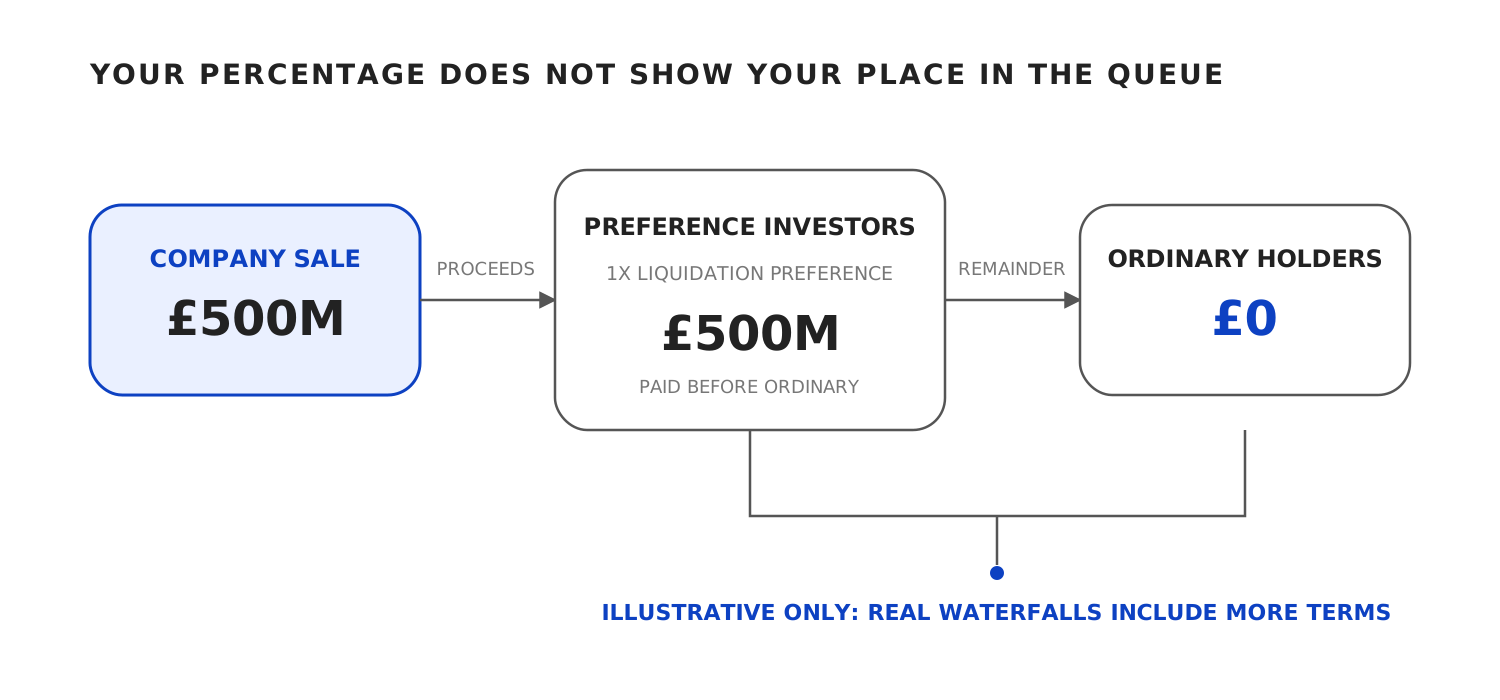
Real transactions are more complicated. Debt, transaction costs, multiple funding rounds, participation rights, conversion terms and retention packages can all change the result.
But the basic lesson survives the complexity.
Your percentage does not tell you where you stand in the queue.
This does not mean liquidation preferences are inherently unfair. Investors put money at risk and negotiate protection for a disappointing exit. It means you should understand those protections before treating your ordinary-share percentage as guaranteed value.
Ask how much money the company has raised. Ask whether the preferences are one times or include a multiplier. Ask whether they participate after receiving the preference. The company may not share every detail, but the question still matters.
Ask these questions before counting options as compensation
When a company gives you an option grant, ask:
- What exactly am I receiving: options, shares or another award?
- How many options am I receiving?
- What percentage is that on a fully diluted basis?
- What is the strike price?
- What was the market value at grant, and was it agreed with HMRC?
- Are these EMI or non-tax-advantaged options?
- What is the vesting schedule and cliff?
- When do the options expire?
- How long do I have to exercise after leaving?
- What happens to the options and their tax treatment if I leave?
- How much money has the company raised?
- What liquidation preferences sit ahead of ordinary shares?
- Has the company previously offered employee liquidity?
- What restrictions apply if I want to transfer or sell the shares?
- Can I read the option plan and grant agreement before deciding?
Then, before exercising, ask a second set of questions:
- How much cash must I spend?
- What tax could become due now?
- Can I afford to lose all of that money?
- What happens if I leave the company?
- Is there any realistic route to liquidity?
- Am I buying because I understand the risk, or because the deadline is making me panic?
You may not receive perfect answers. Private companies are private, after all.
But you should know which answers are missing.
Share options are a structured bet
Share options are not bad compensation. They can create meaningful ownership and give employees a share in the upside they help build.
But they are not salary either.
For the options to become money, several things have to happen. They must vest. You must exercise them before they expire. You must pay the strike price and deal with any tax. The company must create enough value. That value must survive debt, dilution and preferences. And finally, there must be a way to sell.
That is a lot of conditions.
The option is valuable because it gives you a choice. But you can only make a sensible choice if you understand what you were actually given.
Research sources
- Original working note
- GOV.UK: Tax and employee share schemes
- GOV.UK: Enterprise Management Incentives
- HMRC: Get a share scheme valuation
- HMRC: Tax advantages of EMI options
- HMRC: Taxable exercises of EMI options
- HMRC: EMI disqualifying events
- HMRC: Capital Gains Tax on EMI shares
- UK Private Capital: Model Articles of Association