
Fear does not always look afraid
A lot of dysfunctional behaviour may be an attempt to feel safe. The useful question is what fear the behaviour is protecting.
Written May 2020 · Updated Jul 2026
I started researching this because I noticed some of these behaviours in myself. This is as much a lesson for me as it is something I am sharing with you.
Fear is easy to recognise when someone is panicking, freezing or running away.
But it does not always look like that.
I think a lot of dysfunctional behaviour stems from fear. Not all of it, of course. But probably more than we realise.
Someone who behaves arrogantly in a social situation may be trying to prove that they are worthy and interesting because they fear that they are actually not.
Someone who expects other people to guess what they want may be afraid to ask for it. Maybe they fear coming across as selfish. Or, worse, fear that they are secretly selfish.
And someone who avoids conflict may simply be afraid of what the conflict will do. Will it hurt the other person? Will it change how that person sees them? Will the relationship survive it?
We normally stop at the behaviour. We call the person arrogant, passive, difficult or cowardly.
But what if the behaviour we dislike is actually an attempt to feel safe?
That does not excuse it. But it may help us understand what is really going on.
The behaviour makes sense once you find the threat
A dysfunctional behaviour can look completely irrational when you judge it by the eventual outcome.
Arrogance makes people dislike you. If you refuse to ask for what you want, you probably will not get it. And avoiding conflict does not mean the problem disappears. It normally gets worse.
So why would anyone keep behaving this way?
Because, in that moment, they are not trying to create the best long-term outcome. They are just trying to avoid an immediate threat.
The arrogant person may be trying to avoid feeling insignificant. The person who will not ask for what they want may be trying to avoid rejection. And the person avoiding conflict may be trying to avoid disapproval, embarrassment or the possibility of losing the relationship.
And the behaviour works.
But does it actually solve the problem? No. It just removes the discomfort for a moment.
You boast, and briefly feel important. You do not ask, and so you cannot be rejected. You avoid the conversation, and the conflict disappears for the evening.
That small relief is enough to teach you to do the same thing again.
And that is why fear is difficult to recognise. The behaviour is bad for you in the long term. But right now, it works. You feel safe.
The actual problem is still there.
Arrogance can be an attempt to avoid feeling insignificant
Imagine someone walks into a room and immediately starts trying to prove how important they are.
They talk over people. They turn every conversation back to themselves. If someone tells a story, they have done something bigger. If someone knows something, they know more.
You would probably call that person arrogant.
And you may be right. But that only describes the behaviour. It does not explain why they need to behave that way.
What are they trying so hard to prove?
Maybe they are afraid that without the achievements, stories or displays of intelligence, nobody will find them interesting. So they do not allow the room to decide. They control the conversation and keep supplying evidence of their importance.
This is where the behaviour becomes self-defeating.
The person wants to be admired, but their attempt to secure that admiration makes people like them less. They notice people pulling away and take it as further proof that they need to try harder.
So they boast more.
Researchers have found links between insecurity and some forms of self-elevating behaviour. But we should be careful here. Not every arrogant person is secretly insecure, and not every display of confidence is arrogance. Research distinguishes between vulnerable and grandiose forms of narcissism, and insecurity is much more clearly associated with the vulnerable form.
The point is not to diagnose every annoying person you meet.
The point is to ask a better question.
Instead of only asking, "Why does this person think so highly of themselves?", ask:
Why do they need me to think highly of them too?
Expecting people to guess can be a way of avoiding rejection
You want something from another person.
Maybe you want your partner to plan something for your birthday. You want a friend to check in on you. Or you need someone at work to help you.
But you do not ask.
You hint. You become quiet. You mention how tired you are. You wait for them to notice.
And when they do not notice, you feel disappointed.
You might even think:
If they really cared about me, I would not need to ask.
But why not just ask?
Because asking makes what you want visible. And once it is visible, the other person can say no.
There is another fear too. What if asking makes you selfish? What if a good partner, friend or colleague should not need as much as you do?
So instead of asking, you create a test that the other person does not know they are taking.
If they guess correctly, you feel loved. If they do not, it confirms the thing you were already afraid of: they do not care enough.
But that is not a fair test.
The person may care about you deeply and still have no idea what you want. They are working with what you said, while you are judging them using everything you did not say.
Research on rejection sensitivity shows how expecting rejection can make people more alert to any sign of it. It can also lead to defensive behaviour that damages the relationship and eventually creates more of the rejection they were trying to avoid.
So the fear protects itself.
You do not ask because you do not want to hear no. The other person fails to guess. You feel ignored and pull away. They feel the distance but do not understand it, so they pull away too.
Now you have the rejection you were afraid to ask about in the first place.
All because saying, "This is what I want", felt too dangerous.
Avoiding conflict can be an attempt to protect the relationship
Some people are proud of the fact that they avoid conflict.
They say things like:
I do not like drama.
Or:
I would rather keep the peace.
That sounds reasonable. Nobody wants to argue all the time.
But avoiding conflict and keeping the peace are not always the same thing.
You may be upset with your partner, friend or colleague. But you do not say anything because you are afraid of what the conversation might cause.
What if they become angry? What if you hurt them? What if they think you are difficult? What if the relationship changes afterwards?
So you stay quiet.
The problem is that staying quiet does not remove what happened. You are still upset. The other person still does not know what they did. And now they have no chance to explain it, apologise or change their behaviour.
You may start acting differently around them. You reply less. You become colder. Small things begin to annoy you more than they should.
They can see that something is wrong, but you insist that everything is fine.
Now there is still conflict. It is just happening without an honest conversation.
Research into demand-withdraw patterns in relationships has found that avoidance and withdrawal are associated with less problem-solving and poorer conflict resolution.
But there is an important difference here.
Taking an hour to calm down before a difficult conversation is not the same as refusing to have the conversation. Sometimes stepping away is the sensible thing to do. The question is whether you are delaying the conversation so you can handle it better, or avoiding it because you hope the problem will somehow disappear.
Most of the time, it does not disappear.
It waits.
And by the time the conflict finally happens, you are no longer discussing one small thing. You are discussing the small thing, the months of resentment after it, and all the other small things you attached to it.
You avoided a difficult conversation because you wanted to protect the relationship.
But the avoidance may be the thing that damages it.
Why the behaviour survives even when it does not work
If these behaviours keep creating bad outcomes, why do we keep repeating them?
Because they do work.
Just in a very specific and short-term way.
You feel afraid that people will find you uninteresting, so you boast. For a moment, you feel important.
You fear being rejected, so you do not ask for what you want. Now nobody can say no.
You fear a difficult conversation, so you avoid it. The anxiety disappears for the evening.
Fear appears. You do something to escape it. You feel relief.
And your brain remembers the relief.
Psychologists call this negative reinforcement. The word "negative" does not mean the behaviour is bad. It means something uncomfortable has been removed. Because the behaviour removed the discomfort, you become more likely to use it again.
This creates a problem.
Every time you avoid the thing you fear, you also lose the chance to discover that you may have been able to handle it.
Maybe you could have entered the room without proving anything and people would still have found you interesting.
Maybe you could have asked for what you wanted and the person would have said yes. Or they might have said no, and you would have survived that too.
Maybe the difficult conversation would not have destroyed the relationship. It may even have made it better.
But you never get to find out.
The behaviour protects the fear from being tested. And because the fear is never tested, it remains believable.
So the next time the same situation appears, you do what worked before.
You protect yourself again. You feel relief again. And the behaviour becomes a little harder to stop.
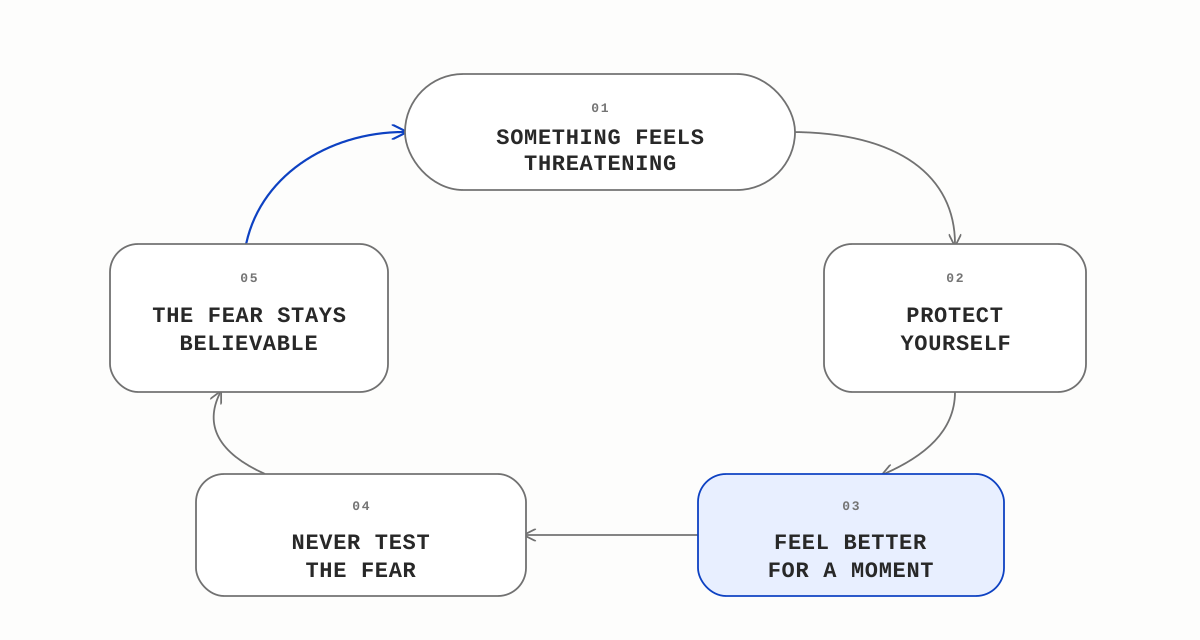
Short-term relief teaches the brain to use the same protection again.
Understanding the fear does not excuse the behaviour
At this point, it would be easy to misunderstand the argument.
If someone behaves arrogantly because they feel insecure, does that mean we should accept the arrogance?
No.
If someone expects you to read their mind because they are afraid of rejection, you are still being asked to pass a test you did not know existed.
And if someone avoids every difficult conversation because they are afraid of losing the relationship, the other person is still left carrying a problem they were never allowed to discuss.
The fear may be real. The effect of the behaviour is also real.
You can understand why someone did something and still tell them that they cannot keep doing it.
This also applies to how we explain our own behaviour.
"I was afraid" can explain why you stayed silent, became defensive or tried too hard to impress people. But it cannot become the reason you keep doing it.
Otherwise, fear becomes a very convenient excuse.
The useful thing about finding the fear is that you now know what needs to change. The problem is not only the arrogance, silence or avoidance that everyone can see. It is also the threat you believe those behaviours are protecting you from.
Both need to be dealt with.
You take responsibility for what you did. And then you ask why doing something different felt so dangerous in the first place.
Ask what the behaviour is protecting
So how do you find the fear behind a behaviour?
Start with something you keep doing that creates an outcome you do not want.
Do not begin with:
Why am I like this?
That question is too big. And it normally ends with you giving yourself a label rather than understanding what happened.
Start with the actual behaviour.
Maybe you ignored a message for three days. You became defensive when someone corrected you. You agreed to something you did not want to do. Or you acted as if nothing was wrong when you were clearly upset.
Then ask:
What exactly did I do?
Describe the behaviour without defending it.
Not, "I was protecting my peace."
You avoided the conversation.
What did I think would happen if I behaved differently?
If you replied to the message, would you disappoint someone?
If you accepted the correction, would you look incompetent?
If you said no, would the person think you were selfish?
This is normally where the fear begins to appear.
What discomfort did the behaviour remove?
Did avoiding the message stop you feeling guilty for a few hours?
Did becoming defensive save you from feeling embarrassed?
Did agreeing to something stop you worrying that the person might dislike you?
Remember, the behaviour survived because it gave you something.
What did that relief cost me later?
You still had to answer the message. The correction became an argument. You agreed to something and became resentful afterwards.
You avoided a small discomfort and created a bigger one.
What is the more direct thing I could do next time?
Reply and tell the person the truth. Accept the correction without turning it into a judgment about your intelligence. Say no instead of saying yes and punishing the person for asking.
This is not a perfect way to explain every behaviour. Sometimes you will not know what you are afraid of immediately.
And when it comes to someone else, do not assume you have discovered their hidden fear just because you have a theory.
Ask them.
The point is not to become an amateur psychologist. It is to stop treating the visible behaviour as the entire problem.
Fear is not always telling you to stop
So far, we have talked about fear as something that can produce bad behaviour.
But fear itself is not always the problem.
Think about what happens before you speak on stage.
Your heart beats faster. Your hands may shake. Your mouth becomes dry. You suddenly become very aware that a room full of people is about to look at you.
Technically, this is usually closer to anxiety than fear. Fear is generally a response to something immediate, while anxiety is what you feel while anticipating something that may happen.
But the feeling is real either way.
The normal advice is to calm down.
What if your body is not telling you to stop? What if it is preparing you to do something difficult?
The physical feeling of anxiety is quite close to excitement. Both can increase your heart rate and make you feel more alert. The difference may partly be how you understand what is happening.
In one study, people were asked to say either "I am calm" or "I am excited" before public speaking. The people who described the feeling as excitement performed better.
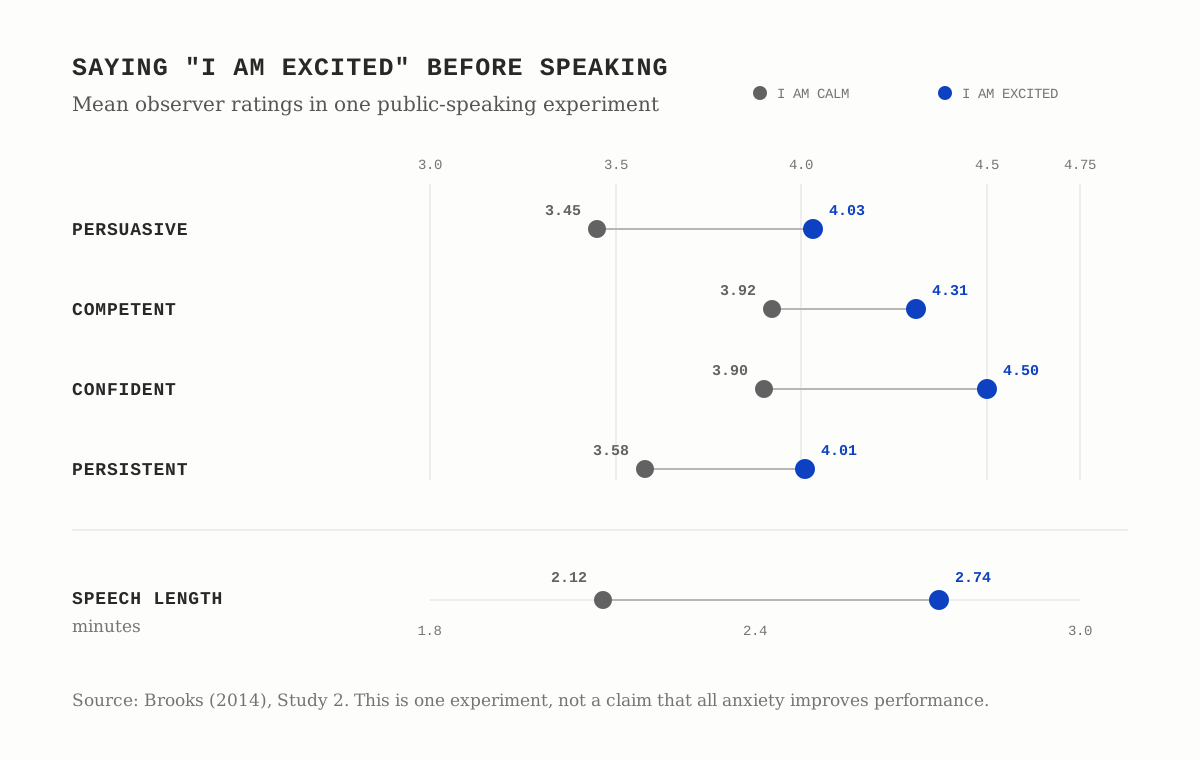
Mean results from one public-speaking experiment. This does not mean all anxiety improves performance.
They did not remove the nerves. They gave the nerves a different job.
That does not mean anxiety is always useful. It can become overwhelming and stop someone functioning normally.
But feeling afraid before something difficult does not automatically mean you should not do it.
Sometimes it means the thing matters to you. Sometimes your body is getting ready.
The question is what you do with the feeling.
Do you use it to pay attention, prepare and act?
Or do you treat it as an instruction to run?
The alternative is not fearlessness
Finding the fear does not make it disappear.
You can understand exactly why you avoid conflict and still feel terrified before the conversation.
You can know that asking directly is healthier and still worry that the other person will say no.
So what do you do?
You act while the fear is still there.
If you wait until you feel completely safe, you may keep repeating the same behaviour for years. The behaviour exists to create safety. It will always give you a reason to use it one more time.
Instead, try the smaller, more direct action.
Enter the room without trying to prove that you are the most interesting person there. Ask people questions. Allow yourself not to know something.
Tell the person what you want instead of leaving clues and hoping they solve them.
Have the difficult conversation. You can even begin with, "I have been avoiding this because I am afraid of what it might do to our relationship."
Will the thing you fear sometimes happen?
Yes.
Someone may say no. A person may think less of you. A difficult conversation may change a relationship.
The point is not that your fears are always imaginary. The point is that avoiding them also has a cost, and you have been pretending that cost is safer because it arrives later.
You are choosing between two forms of discomfort.
One gives you relief now and normally leaves the actual problem in place.
The other feels worse now, but gives you the chance to find out what is true, solve the problem or at least deal with it honestly.
You do not need to become fearless.
You need to stop making fear the only person allowed to decide what you do.
Takeaway
The next time you notice yourself behaving in a way that does not make sense, do not stop at the behaviour.
Ask a more useful question:
What am I afraid would happen if I behaved directly?
If you are trying to prove how interesting you are, what do you think would happen if you stopped proving it?
If you are waiting for someone to guess what you want, what are you afraid will happen if you ask?
If you are avoiding a difficult conversation, what exactly do you think the conversation will destroy?
Write the answer down plainly. Not the impressive answer. The honest one.
Then choose the smallest action that tests it.
You do not need to tell the whole room that you feel insecure. You can enter one conversation without trying to impress anyone.
You do not need to become perfectly direct overnight. You can ask for one thing instead of leaving another clue.
You do not need to solve the entire relationship in one evening. You can begin the conversation you have been avoiding.
The fear may still be there.
That is fine.
The point is not to remove fear before you act. It is to notice when fear has disguised itself as your personality, your standards or simply the way you do things.
A lot of dysfunctional behaviour may begin as an attempt to feel safe.
But if the protection keeps creating the actual problem, it is not protecting you anymore.
Research sources
Rethinking Avoidance: Toward a Balanced Approach to Avoidance in Treating Anxiety Disorders
Safety behaviours in social anxiety: an examination across adolescence
Examining psychological inflexibility as a transdiagnostic process across psychological disorders
Rejection sensitivity and disruption of attention by social threat cues
The nonlinear association between grandiose and vulnerable narcissism
Get excited: reappraising pre-performance anxiety as excitement